Natural wonders · last checked 5 October 2026
Bioluminescence in Andaman: the pre-dawn kayak trip at Havelock
The bioluminescence trip we arrange in the Andamans is a guided kayak outing at Havelock, not a beach you walk to. Pickup is at 3 in the morning, you are on dark water by about 4, and you stay out as the sky lightens. Here is how the trip runs, which mornings of the 2026–27 season have no moon in the sky, what it cost in July 2026, and what nobody can promise.
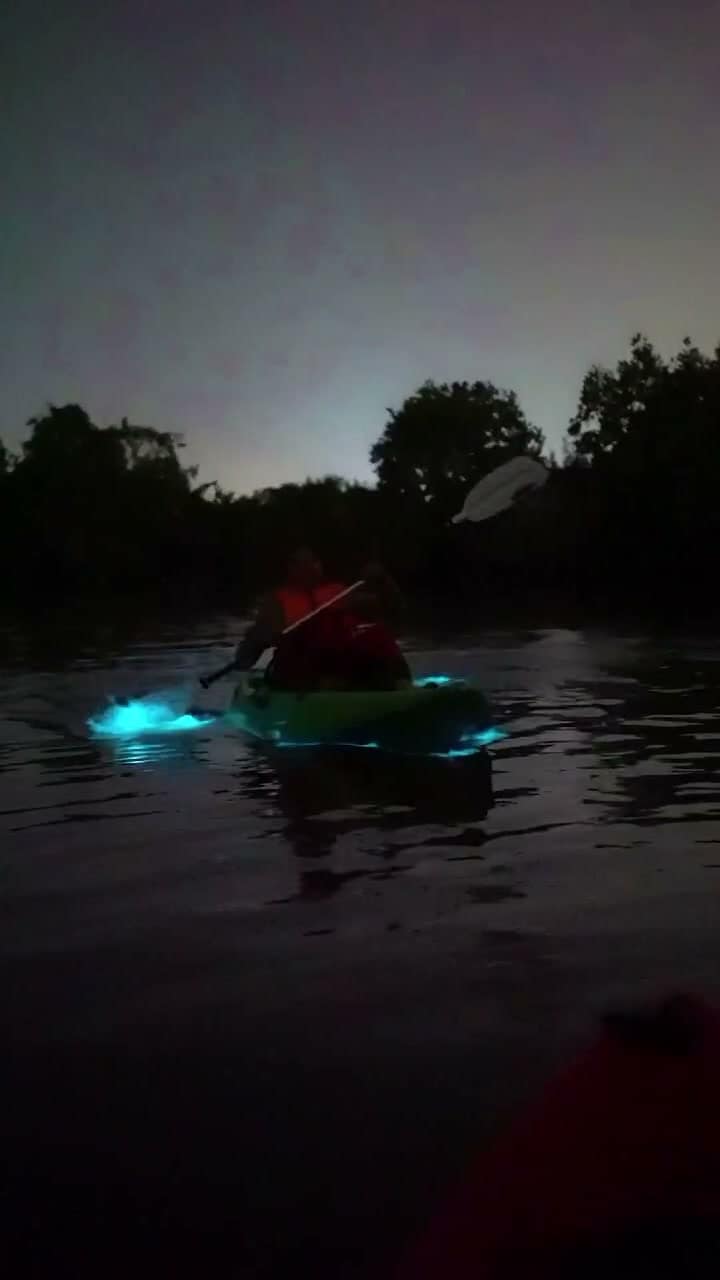
Real, from one of our trips — no filter, no fake glow. You will not be filming this yourself: phones stay behind on the dark water, which is exactly why our team captured it, so you can just paddle and watch.
What the glow actually is
The light comes from plankton. Dinoflagellates — single-celled organisms — are the most common source of light at the sea surface, according to the Latz Laboratory at the Scripps Institution of Oceanography. A cell flashes when the water around it is disturbed: by a wave, a swimming animal or a paddle. Each flash lasts about a tenth of a second, so a trail fades almost as soon as it forms. The lab describes the flash as a defence: it startles the animals that feed on the plankton. The cells also keep a daily rhythm — the light is switched off during the day, and exposure to light suppresses it at night — so it can only be seen in the dark. Nothing is added to the water.
Which species lights the water off Havelock is not something we can cite a study for, so we do not name one. Many travel pages name Noctiluca scintillans, a dinoflagellate whose blooms can glow at night (NASA Earth Observatory). The nearest published record we know of is a run of blooms of that species in Port Blair Bay in June and July 2000 (Current Science, 2001) — a different place and a different season from this trip.
How the night actually runs
Pickup from your hotel. It is that early because the glow can only be seen in the dark.
Reach the jetty. Life jackets on, then a 10–15 minute kayak briefing so you are steady on the water before you push off.
On the water. When the plankton is there, your paddle and hands leave a blue-green trail through the dark sea.
Stay out as the sky lightens. First light comes between about 4:30 and 5:20 AM depending on the month, and sunrise a little over 20 minutes after it; the month-by-month times are below.
Session ends. Back at your hotel around 6:00. The whole activity runs about two hours.
These timings are from our operations manager's note of 4 July 2026. From mid-December to early March the sun rises at 5:30 AM or later at Havelock, so on those mornings a session timed like this ends at or before sunrise.
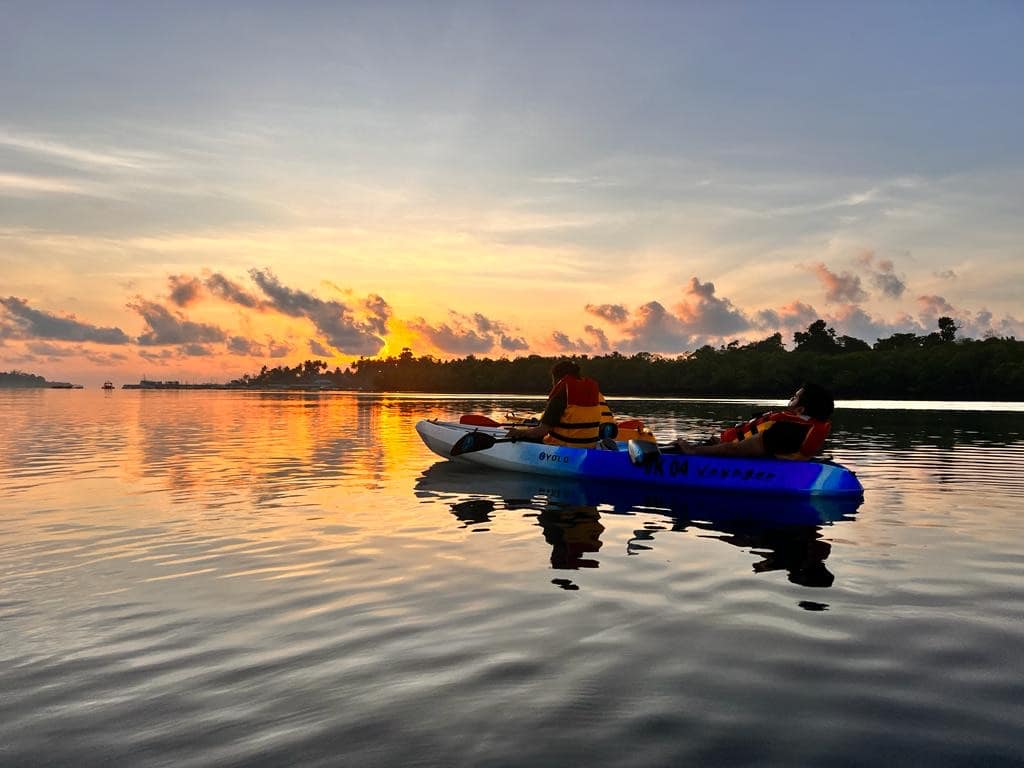
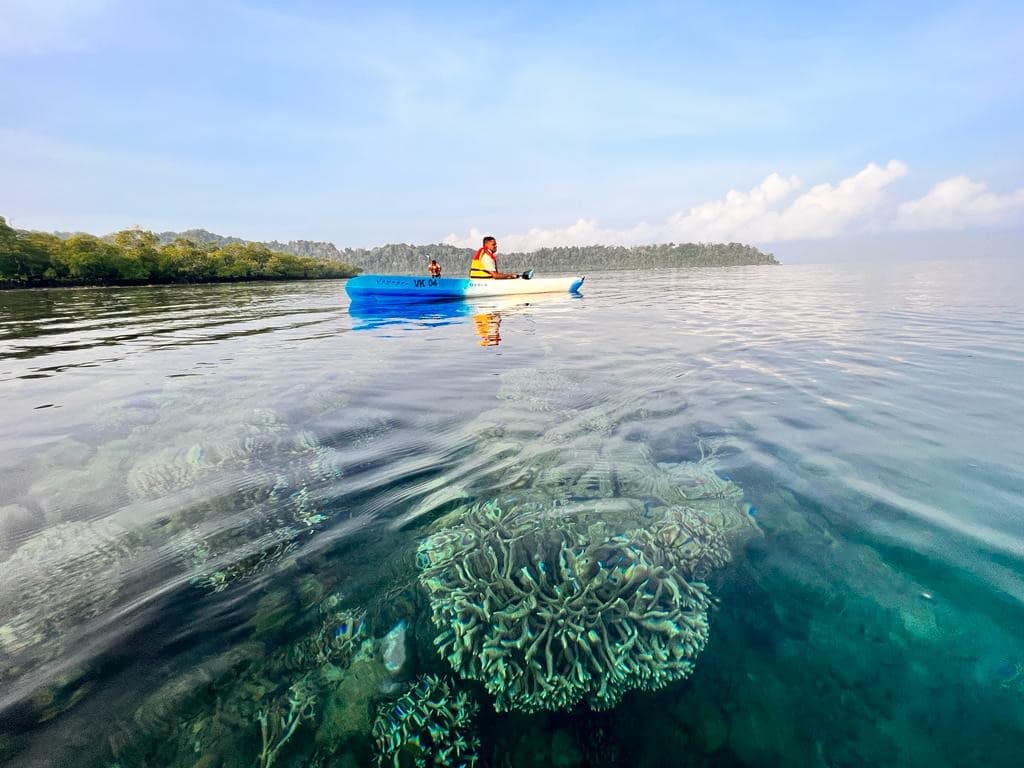
Kayaks are single or double — a double seats a couple or two friends — and a guide stays with you on the water the whole time. Wear normal, comfortable clothes: a t-shirt and track pants are ideal. You will get wet.
What decides how much you see
- Moon
A moon in the sky makes a faint glow harder to see. For a trip that is on the water at 4 AM the question is whether the moon is up before dawn, not how close the date is to a new moon. The first table below lists the mornings with none.
- Dawn
The glow cannot be seen once the sky is bright. First light and sunrise move by about fifty minutes across the season; the second table has them by month.
- Sea
The trip needs water calm enough to kayak. Our weather record by month is in the second table.
- Plankton
How much plankton is in the water on your morning is the part nobody controls, and we know of no forecast for it.
- You
It is a kayak on dark water at 4 AM. You should be comfortable on a boat and able to follow the guide — this is why the trip is guide-led with a briefing first.
The mornings with no moon: 2026–27 season
The usual advice is to go near a new moon. For a trip that is on the water at 4 AM, the useful mornings are the ones after it. A waxing moon sets before the trip starts, so each new moon is followed by twelve to fourteen mornings with no moon in the sky before dawn. Then come eight to ten mornings with a bright moon overhead, from just before the full moon until it has waned to half, and after that about a week with a thinning crescent.
| New moon | No moon before dawn | Bright moon before dawn |
|---|---|---|
| Sat 10 Oct 2026 | 11–24 Oct | 25 Oct – 1 Nov |
| Mon 9 Nov 2026 | 9–22 Nov | 23 Nov – 1 Dec |
| Wed 9 Dec 2026 | 9–22 Dec | 23–30 Dec |
| Fri 8 Jan 2027 | 8–20 Jan | 21–29 Jan |
| Sat 6 Feb 2027 | 6–18 Feb | 19–28 Feb |
| Mon 8 Mar 2027 | 8–20 Mar | 21–30 Mar |
| Wed 7 Apr 2027 | 7–18 Apr | 19–28 Apr |
| Thu 6 May 2027 | 7–18 May | 19–28 May |
US Naval Observatory data for Havelock (11.98°N, 92.95°E), in Indian Standard Time. “No moon” means the moon is below a sea-level horizon for the whole stretch from 3:30 AM, when the trip reaches the jetty, to first light. “Bright moon” means it is above the horizon for some or all of that stretch and at least half lit (between its first and last quarter). The mornings not listed have a moon in the sky too: a waning crescent in the week or so before each new moon, and a bright moon on 1–3 October. This is a table of the sky, not of the plankton: a morning with no moon can still have little or no glow.
First light, sunrise and the weather record by month
| Month (15th) | First light | Sunrise | Weather record |
|---|---|---|---|
| October | 4:47 AM | 5:08 AM | 13 dry days in 30 · sea: calming |
| 13 dry days in 30 · sea: calming | |||
| November | 4:53 AM | 5:15 AM | 16 dry days in 30 · sea: calm |
| 16 dry days in 30 · sea: calm | |||
| December | 5:07 AM | 5:30 AM | 21 dry days in 30 · sea: calm, not the flattest |
| 21 dry days in 30 · sea: calm, not the flattest | |||
| January | 5:20 AM | 5:43 AM | 26 dry days in 30 · sea: calm |
| 26 dry days in 30 · sea: calm | |||
| February | 5:18 AM | 5:40 AM | 28 dry days in 30 · sea: calm |
| 28 dry days in 30 · sea: calm | |||
| March | 5:05 AM | 5:26 AM | 28 dry days in 30 · sea: calm |
| 28 dry days in 30 · sea: calm | |||
| April | 4:45 AM | 5:07 AM | 26 dry days in 30 · sea: flattest of the year |
| 26 dry days in 30 · sea: flattest of the year | |||
| May | 4:32 AM | 4:54 AM | 14 dry days in 30 · sea: rough spells |
| 14 dry days in 30 · sea: rough spells | |||
First light is the start of civil twilight, from the same US Naval Observatory data; the sky begins to pale before it. Dry days are the Port Blair airport gauge's ten-year average and the sea notes are the ones on our weather and best-time pages. On that record January to April are the safer months for a kayak morning, with April the flattest sea; October and May are shoulder months, with showers still common in October and rough spells in May. No month guarantees a calm morning.
When it runs
The trip runs every night through the season, roughly October to May. It does not run in the monsoon off-season: rough seas close the kayaking, so there is no bioluminescence trip in those months. Within the season it is scheduled nightly whatever the moon; what varies is how much glow there is. The month-by-month weather is on our weather and best-time page. Most guests pair this with a longer stay on the island — see our Havelock Island guide for the beaches and ferries.
Where you can see it, and the beach question
The trip we arrange is at Havelock (Swaraj Dweep): kayaks launched from a jetty, with a guide alongside. We do not offer it from Neil Island or Port Blair.
People often search for a bioluminescent beach in the Andamans. We cannot point you to one. Radhanagar is one of the beaches travel pages name, but the A&N Tourism Directorate's beach management plan regulates visits there between sunrise and sunset, so it has no night access. We have not verified any beach in the islands where the glow can be seen from the sand, so we do not name one.
“The entire trip was managed with excellent organization … They also helped us with our bookings for Scuba and Kayaking.”
— sagar, Nov 2025, 5★ Google review
Questions, answered straight
What is bioluminescence, really?
It is light made by living organisms. At the sea surface the most common source is dinoflagellates, single-celled plankton that flash blue-green when the water around them is disturbed. Move a paddle or a hand through the water on the right morning and a trail lights up; each flash lasts about a tenth of a second. It is a defence reflex in the plankton, not a chemical in the water and nothing added by anyone.
Where can you see bioluminescence in Andaman?
On a guided kayak trip at Havelock (Swaraj Dweep). The kayaks launch from a jetty and a guide stays with you on the water; you paddle out into the dark rather than wade in from a beach. Kayaks are single or double. That is the only way we arrange it. We do not offer it from Neil Island or Port Blair.
Is there a bioluminescent beach in Andaman?
Not one we can point you to. Radhanagar Beach is often named online, but the A&N Tourism Directorate's beach management plan regulates visits there between sunrise and sunset, so it has no night access. We have not verified any beach in the islands where the glow can be seen from the sand, so we do not name one. The bioluminescence we know is seen from a kayak off Havelock.
What time does the bioluminescence trip start and end?
Pickup is at 3:00 AM, you reach the jetty by 3:30, and after life jackets and a 10–15 minute briefing you are on the water at about 4:00. The session ends by 5:30 and you are back at your hotel around 6:00 — about two hours in all. Those are the timings in our operations note of July 2026. First light at Havelock comes between about 4:30 and 5:20 AM depending on the month.
Which nights are best for bioluminescence in Andaman?
For a trip that is on the water at 4 AM, the mornings after a new moon, not the week around it. A waxing moon has set by then, so each new moon is followed by twelve to fourteen mornings with no moon before dawn. In the 2026–27 season those are 11–24 October, 9–22 November, 9–22 December, 8–20 January, 6–18 February, 8–20 March, 7–18 April and 7–18 May, by US Naval Observatory data for Havelock. The eight to ten mornings after each of those runs have a bright moon in the sky. A dark sky makes a faint glow easier to see; it does not put plankton in the water.
What does it cost, and what is included?
₹3,500 per person in our operations note of July 2026, for the guided kayaking session only — no meals or extras. Send us your dates and we will confirm the current rate; do not plan around a figure from a page.
Can I take photos or videos?
Not from the kayak — on dark water a phone is a liability, and the glow barely registers on a phone camera anyway. Leave it behind and just watch. Our own team filmed the footage on this page: real bioluminescence, no filter — so you can see what it looks like without spending the night staring at a screen.
Is the glow guaranteed?
No. The trip is scheduled every night in season, but the glow is a living thing's reaction, and how much there is on your morning depends on the plankton, the moon and the sea, none of which anyone controls. Some mornings it is strong and some faint. We know of no forecast for it. What can be known in advance is the moon and the time of first light, and both are in the tables on this page.
Does the bioluminescence trip run all year?
No. It runs through the season, roughly October to May, and not in the monsoon months, when rough seas close the kayaking.
How this page stays true
Written by the Tropical Andamans editorial team · last checked 5 October 2026. The itinerary, timings and price are from our operations manager's note of 4 July 2026, and the season is as the owner confirmed it that day; none of them has been re-confirmed since, so ask us for the current rate and timings. The moon, first-light and sunrise times were taken from the US Naval Observatory on 5 October 2026 and are astronomy, not a promise about the sky or the water. The weather notes are the ones on our weather pages. What the glow is comes from the Latz Laboratory at the Scripps Institution of Oceanography. Bioluminescence is a natural event nobody controls, and how much of it you see is never promised.
Ask us about your dates.
Send your travel nights and we will tell you what the moon is doing on those mornings and the current rate — and book the kayak trip if you want it.